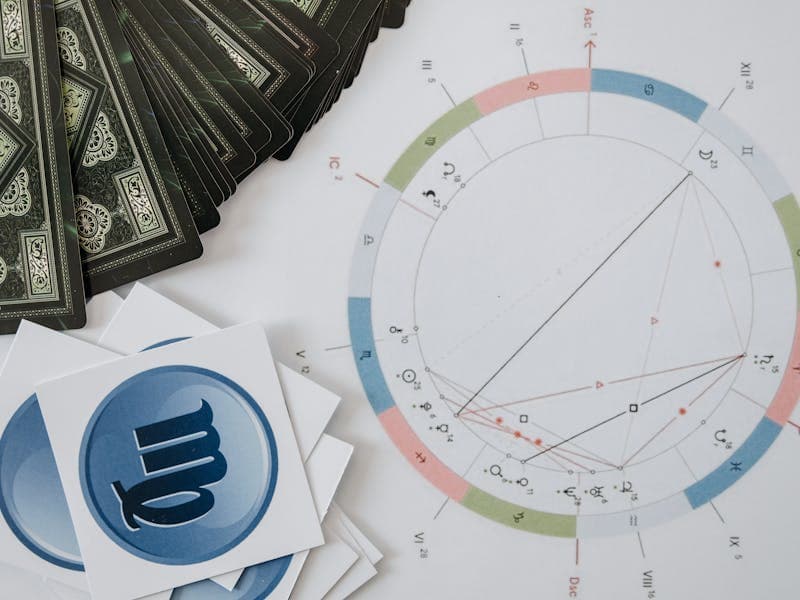
How to Read Your Vedic Birth Chart: Houses, Planets, and Signs
Learning how to read a birth chart feels like staring at a clock with no numbers until someone shows you where to start. Once you know the order, a Vedic birth chart becomes readable. This guide walks you through it the way a careful astrologer would: find your Lagna, learn the twelve houses, place the nine planets, check each sign, then put the pieces together. No jargon left unexplained, and no fortune-telling either, just a steady method you can actually practice.
Start With Accurate Birth Data
Everything in a Vedic chart hangs on three numbers: your date of birth, your exact time of birth, and your place of birth. Date is usually easy. Time is the one that trips people up, because the whole chart can shift if the time is off by even a few minutes. The Lagna (ascendant) changes signs roughly every two hours, and some of the finer divisional charts move much faster. If your recorded time is rounded or guessed, treat your reading as approximate until you confirm it.
Place matters because the astrologer converts your local clock time into a precise position of the sky over that exact spot on Earth. A birth in Mumbai and a birth in London at the same clock time produce completely different charts. Once you have the data, you generate the chart. If you want a fuller picture of what that chart even is before you read on, our explainer on what a Kundali is is a good companion to this guide.
On birth time
If you do not know your birth time, you can still get value from the Moon's sign and nakshatra, which a skilled astrologer can sometimes work with. But house-based reading, the heart of this article, needs a reliable time. A process called birth-time rectification exists for this, and it is its own craft.
Read Vedic Birth Chart Basics: The Lagna and the First House
The single most important point in your chart is the Lagna, also called the ascendant. It is the sign of the zodiac that was rising on the eastern horizon at the moment you were born. To read a Vedic birth chart, you find the Lagna first and build outward from there. The Lagna becomes your first house, the house of the self: your body, your temperament, your overall vitality, and the lens through which you meet the world.
Vedic astrology uses the sidereal zodiac, which is tied to the fixed stars rather than the seasons. This is one reason a Vedic chart can show a different rising sign and different planetary signs than a Western chart you may have seen. There are twelve rasis, the familiar signs from Aries (Mesha) through Pisces (Meena), and your Lagna is whichever one was climbing the horizon at your birth. If you want the deeper mechanics of why the sidereal system matters, we cover it in how Jyotish works.
Once the first house is set, the other eleven houses follow in fixed order around the chart. In the North Indian style the houses stay in place and the signs move through them; in the South Indian style the signs stay fixed and you locate the Lagna among them. Either way, the meaning of each house is the same. Learn the houses once and the chart style is just a layout choice.
Walk the Twelve Houses
The twelve bhavas, or houses, are the stage on which the planets act. Each governs a cluster of life themes. This is the backbone of all house reading, so it is worth memorizing the core meaning of each one. Here is the standard set of significations.
- First house: the self, body, vitality, personality, and how you appear to others.
- Second house: wealth, accumulated resources, family of origin, food, and speech.
- Third house: courage, effort, younger siblings, hands and communication, short journeys.
- Fourth house: home, mother, property, vehicles, education, and inner emotional comfort.
- Fifth house: children, creativity, intelligence, romance, and the merit you carry from the past.
- Sixth house: health and illness, daily work, debts, conflicts, and adversaries.
- Seventh house: marriage, the spouse, business partnership, and one-to-one relationships.
- Eighth house: longevity, transformation, hidden matters, inheritance, and sudden change.
- Ninth house: fortune, dharma, higher learning, the father, teachers, and long journeys.
- Tenth house: career, public status, action in the world, and reputation.
- Eleventh house: gains, income, friendships, networks, and the fulfillment of desires.
- Twelfth house: loss and expenditure, foreign lands, sleep and dreams, retreat, and liberation.
Notice the pattern. The houses run from the most personal (the self in the first) outward to the most universal (release and liberation in the twelfth). Houses one, four, seven, and ten are the strongest action points, called the kendras or angles. Houses one, five, and nine form the trine of fortune and dharma, called the trikonas, and they are considered the most benefic. Houses six, eight, and twelve are the difficult houses, the dusthanas, which deal with struggle, crisis, and loss, though they also carry growth that comfortable houses cannot give.
Meet the Nine Grahas and What They Signify
Vedic astrology works with nine grahas, usually translated as planets, though two of them are the Moon's nodes rather than physical bodies. When you read planets in Vedic astrology, you are reading these nine and nothing else. Each carries a natural set of meanings, called its karakas, that hold true wherever the planet sits.
- Sun (Surya): the soul, vitality, the father, authority, and self-expression.
- Moon (Chandra): the mind, emotions, the mother, comfort, and the public.
- Mars (Mangala): energy, courage, drive, conflict, siblings, and property.
- Mercury (Budha): intellect, speech, commerce, learning, and analysis.
- Jupiter (Guru): wisdom, expansion, teachers, children, ethics, and grace.
- Venus (Shukra): love, beauty, art, pleasure, marriage, and refinement.
- Saturn (Shani): discipline, time, labor, delay, endurance, and hard lessons.
- Rahu: the north node, ambition, obsession, foreign things, and amplification.
- Ketu: the south node, detachment, spirituality, loss, and sharp focus.
Reading a planet means holding two layers at once: its natural significations (Jupiter is always about wisdom and children) and the house it actually sits in (Jupiter in the seventh house brings that wisdom to bear on marriage and partnership). Beginners often rush to verdicts. The patient move is to name the planet's nature first, then ask what part of life it has landed in.

Check Each Planet's Sign and Dignity
A planet behaves differently depending on which of the twelve signs it occupies. This is called its dignity, and it tells you how comfortably the planet can act. The key states to learn are own sign, exaltation, and debilitation.
Each planet rules one or two signs where it feels at home and acts with strength, called its own sign or swakshetra. Each planet also has one sign where it is exalted, its high point of expression, and the opposite sign where it is debilitated, its weakest footing. The Sun is exalted in Aries and debilitated in Libra. The Moon is exalted in Taurus and debilitated in Scorpio. Saturn is exalted in Libra and debilitated in Aries. A debilitated planet is not doomed, and there are classical conditions that can cancel or soften debilitation, but dignity is your quick read on whether a planet is working with the grain or against it.
A quick dignity check
When you look at any planet, ask three things in order. What sign is it in? Is that sign friendly, own, exalted, or debilitated for this planet? What house does that sign fall in for your Lagna? Those three answers already give you a usable first impression before you touch anything advanced.
Follow the House Lords
Here is the step that turns a flat chart into a living one. Every house has a lord, which is simply the planet that rules the sign on that house. The lord carries the affairs of its house wherever it travels. So you read a house twice: once for the planets sitting inside it, and once for where its lord has gone.
Say your tenth house of career is the sign Cancer; the Moon rules Cancer, so the Moon is your tenth lord. Now you find the Moon in the chart. If it sits in the eleventh house of gains, you have a thread connecting career to income and networks. If it sits in the twelfth house of foreign lands and retreat, the career story leans toward distant places or work behind the scenes. The connection between a house and where its lord lives is one of the most reliable reading tools in Jyotish, and it rewards slow, careful tracing.
The strength and placement of the lord of a house must be examined to judge the results of that house.— Brihat Parashara Hora Shastra
A First Look at Yogas and Aspects
When planets relate to each other in particular ways, the combination is called a yoga. There are hundreds in the classical texts, but a beginner only needs the idea: certain placements reinforce or complicate each other, and the whole can mean more than the parts. A Raja yoga, broadly, is a fortunate combination formed when lords of angles and trines connect, often supporting status and achievement. A Gaja Kesari yoga forms when Jupiter and the Moon hold a strong angular relationship and is associated with intelligence and good standing.
Planets also cast drishti, or aspect, meaning they influence other houses by sight. Every planet aspects the house directly opposite it. Mars, Jupiter, and Saturn have special additional aspects: Mars aspects the fourth and eighth houses from itself, Jupiter the fifth and ninth, and Saturn the third and tenth. Aspects are how a planet reaches across the chart to color a house it does not occupy. Do not over-collect yogas as a beginner. Get the houses, planets, signs, and lords solid first, then let yogas add nuance.
Read the Timing With Vimshottari Dasha
A natal chart shows your potential, but it does not, on its own, tell you when themes activate. For that, Vedic astrology uses the dasha system, most commonly Vimshottari dasha, a 120-year cycle in which each of the nine planets governs a period of your life in a fixed sequence. Your starting point in the cycle is set by the nakshatra your Moon occupied at birth, one of the 27 lunar mansions.
During a planet's major period, its themes and the houses it rules and occupies tend to come forward. If you are in a Jupiter period and Jupiter is well placed and dignified in your chart, the period often supports the growth and expansion Jupiter signifies. Each major period is divided into sub-periods ruled by the other planets, which adds finer timing. Reading the current dasha is what lets an astrologer talk about a particular chapter of life rather than the whole map at once.
Potential versus timing
Houses, planets, and signs describe what is possible in your chart. The dasha describes when those possibilities tend to ripen. A strong placement that is not yet activated by its period may simply be waiting for its season.
Cross-Check With the Navamsa
The chart you have been reading so far is the Rasi chart, also called the D1, the main birth chart. Vedic astrology also uses divisional charts that zoom into specific areas of life. The most important is the Navamsa, or D9, which divides each sign into nine parts and is read especially for marriage and for the underlying strength of the planets.
A common method is to look at a planet in both charts. A planet that looks strong in the Rasi chart but weak in the Navamsa may promise more than it delivers, while a planet that gains dignity in the Navamsa is said to be vargottama and is considered notably steady. For relationship questions in particular, experienced astrologers read the seventh house and Venus across both the Rasi and the Navamsa rather than trusting the main chart alone. This is also where reading earns its honesty: charts show tendencies, not fixed verdicts, and a careful reader holds them as possibilities.
A Worked Mini-Example: Mars in the Seventh
Let us put the method to work on a single placement so you can see the steps. Suppose someone has Mars in the seventh house. Step one, name the planet's nature: Mars is energy, drive, courage, and at times friction and conflict. Step two, name the house: the seventh is marriage and one-to-one partnership. Put them together and the seventh house receives a strong dose of Martian energy.
What might that mean? It can show a person who brings passion and initiative into partnership, who is drawn to strong-willed partners, and who may need to watch for impatience or heat in close relationships. Now refine it. What sign is Mars in here, and is that dignity comfortable or stressed? Which house does Mars also rule from this position, and is any benefic like Jupiter or Venus aspecting the seventh to soften it? The same Mars in its own sign with a Jupiter aspect reads very differently from a debilitated Mars sitting alone. This is the difference between a label and a reading, and it is why the same placement is never a single fate.
Notice what we did not do. We did not say marriage will fail or succeed. A placement opens a theme to work with, and the rest depends on the whole chart, the dasha running, and the choices a person makes. Honest astrology stays on the side of insight, not prediction of doom.
Where to Take Your Practice Next
If you read your chart in the order we laid out, find the Lagna, learn the twelve houses, place the nine grahas, check each sign and its dignity, trace the house lords, glance at a yoga or two, read the current dasha, and cross-check the Navamsa, you already have a sound beginner method. The skill comes from repetition. Read your own chart, then a family member's, then a friend's, and watch how the same principles bend to different lives.
There is a point where self-study reaches its limit, and that is normal. Synthesizing a whole chart, weighing conflicting indications, and timing them with care is what years of study and a good teacher are for. If you would like a trained eye on your own chart, you can create an account and generate your chart on pyastro, or find an astrologer for a personal reading. Use this guide to understand what they show you, and to ask sharper questions. A reading you can follow is worth far more than one you simply receive.
Frequently asked questions
- How do I read my birth chart as a complete beginner?
- Start by finding your Lagna, the rising sign, which becomes your first house. Learn what each of the twelve houses governs, then place the nine planets and note which sign each one is in. Once those basics are solid, trace where each house lord sits and read the current dasha for timing.
- What is the Lagna or ascendant in a Vedic birth chart?
- The Lagna is the sign of the zodiac that was rising on the eastern horizon at your exact moment of birth. It becomes your first house and represents your body, temperament, and overall vitality. Because it shifts roughly every two hours, an accurate birth time is essential to fix it correctly.
- What is the difference between a Rasi chart and a Navamsa chart?
- The Rasi chart, or D1, is the main birth chart showing the placement of planets across the twelve signs and houses. The Navamsa, or D9, divides each sign into nine parts and is read especially for marriage and for the underlying strength of the planets. Astrologers often check a planet in both charts before drawing conclusions.
- What does it mean when a planet is exalted or debilitated?
- Exaltation is the sign where a planet expresses itself at its strongest, and debilitation is the opposite sign where it is weakest. For example, the Sun is exalted in Aries and debilitated in Libra. A debilitated planet is not doomed, since classical rules can cancel or soften the weakness, but dignity gives you a quick read on how comfortably a planet can act.
- What is Vimshottari dasha used for?
- Vimshottari dasha is a 120-year cycle in which each of the nine planets rules a period of your life in a fixed sequence. It is the main tool for timing, showing when the themes of a planet and the houses it governs tend to come forward. Your starting point is set by the nakshatra your Moon occupied at birth.
- Why does my Vedic rising sign differ from my Western one?
- Vedic astrology uses the sidereal zodiac, which is tied to the fixed stars, while most Western astrology uses the tropical zodiac, tied to the seasons. The gap between the two systems means your sidereal Lagna and planetary signs can differ from a Western reading by close to a full sign. Neither is wrong; they are simply different reference frames.
- Can I read my own chart accurately without an astrologer?
- You can learn a great deal on your own, especially the houses, planets, signs, and house lords covered in this guide. Synthesizing a full chart, weighing conflicting indications, and timing them well is harder and usually benefits from training or an experienced reader. A good approach is to study the basics yourself so you can follow and question a professional reading rather than just receive it.
The pyastro Editorial Team
pyastro pairs the classical Parashari tradition with a precise calculation engine so the astrology you read here matches the charts professional astrologers cast. Every article is reviewed for accuracy against classical Jyotish sources.
Ready to see your own birth chart?
Generate a free, accurate Vedic Kundali and explore your Rasi chart, Navamsa, planetary positions, and dasha periods.