What Is a Kundali? A Complete Guide to Your Vedic Birth Chart
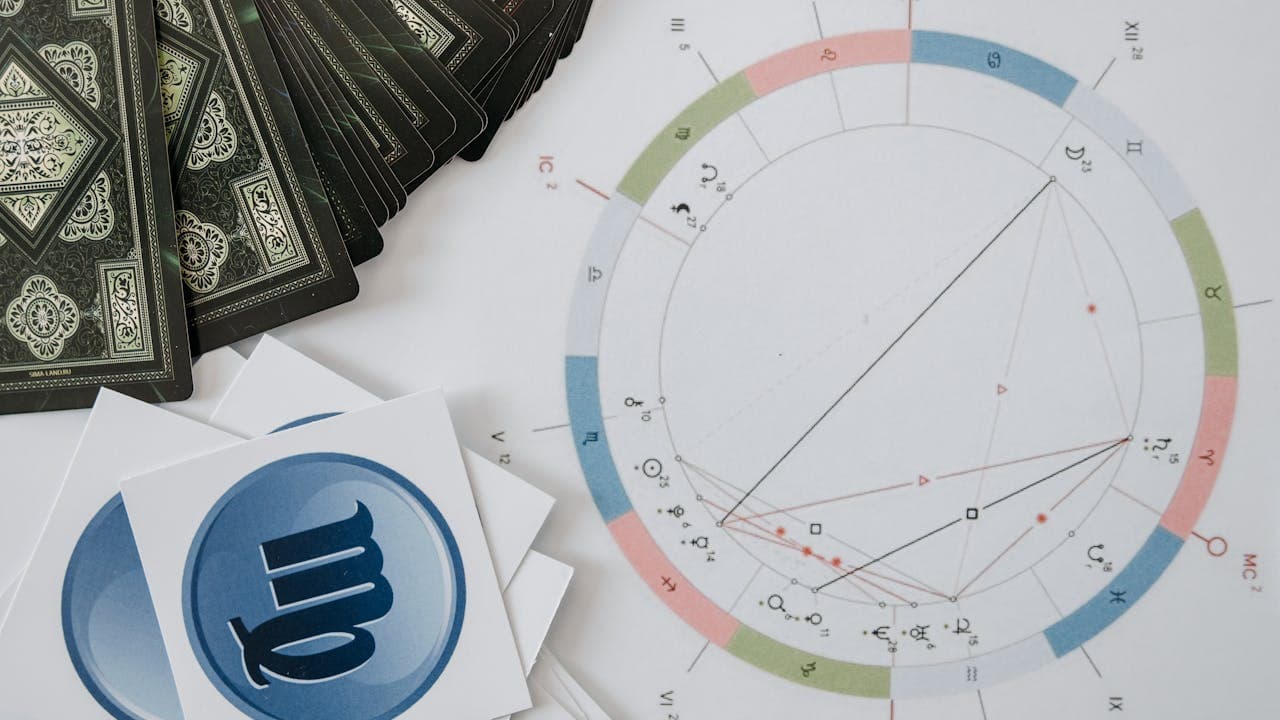
So what is a Kundali, really? In plain terms, a Kundali is your Vedic birth chart, a precise diagram of where the planets and signs sat in the sky at the exact moment and place you were born. It is sometimes called a Janam Kundali or Janam Kundli, and it is the foundation of everything in Jyotish, the Vedic astrology of India. Whatever an astrologer eventually tells you about temperament, timing, or relationships, it all begins with this single map.
Kundali Meaning: A Snapshot of the Sky at Your Birth
The Kundali meaning is best understood through one image. Imagine the heavens as a great wheel turning slowly overhead. At the instant you took your first breath, that wheel froze. Where each planet stood against the backdrop of the zodiac, and which sign was rising on the eastern horizon, became fixed for you alone. A Kundali is the written record of that frozen sky.
This is why two people born minutes apart in the same hospital can have noticeably different charts. The fast-moving rising sign and the Moon shift quickly, so even a small gap in time changes the picture. Your Vedic birth chart is personal in a way that few things are, because it captures a configuration of the sky that, in practical terms, belongs to you.
A note on spelling
You will see Kundali, Kundli, and even Kundali chart used interchangeably online. They all point to the same thing: the Vedic horoscope cast for a person's birth. Janam simply means birth, so a Janam Kundali is a birth Kundali.
The Three Things a Kundali Needs: Date, Time, and Place
To cast an accurate chart you need exactly three pieces of information, and all three matter.
- Date of birth, which fixes the positions of the slower planets like Jupiter and Saturn.
- Exact time of birth, ideally to the minute, because this sets the Lagna or ascendant, the most personal point in the whole chart.
- Place of birth, the city and country, because the sky looks different from different points on the Earth at the same instant.
Birth time deserves special attention. The Lagna, the sign rising on the eastern horizon, moves through all twelve signs in roughly twenty-four hours, which means it shifts to a new sign about every two hours. Get the time wrong by an hour or two and the entire house framework can rotate, placing your planets in different bhavas and changing the reading. If you do not know your birth time, a good astrologer can sometimes work backward from life events through a process called rectification, but a recorded time from a hospital or birth certificate is far better.
Find your birth time first
Before you generate a chart, dig up your birth certificate or ask a parent for the recorded hour. A precise time is the single biggest factor in a chart's accuracy, more than any software or technique.
What Is Actually on the Chart
Open any Kundali and you are looking at a diagram divided into twelve compartments. Each compartment is a house, and into those houses fall the signs and the planets. Four ingredients make up the whole picture.
The Twelve Bhavas (Houses)
The twelve bhavas are the areas of life. The first house concerns the self, body, and overall direction. Others govern wealth, family, courage, children, health, partnership, longevity, fortune, career, gains, and loss or liberation. Where a planet sits by house tells an astrologer which part of your life it colors most strongly.
The Lagna (Ascendant)
The Lagna is the sign that was rising on the eastern horizon at your birth. It anchors the entire chart and becomes the first house. Think of it as the lens through which the rest of the planets are read. Two people can have the Sun in Leo, but if their Lagnas differ, that same Leo Sun lands in different houses and means very different things.
The Twelve Rasis (Signs)
The twelve rasis are the zodiac signs, from Mesha (Aries) through Meena (Pisces). They describe the quality or flavor of energy in a given area, while the houses describe the area itself.
The Nine Grahas (Planets)
Jyotish works with nine grahas: the Sun (Surya), Moon (Chandra), Mars (Mangal), Mercury (Budha), Jupiter (Guru), Venus (Shukra), Saturn (Shani), and the two lunar nodes, Rahu and Ketu. The nodes are not physical bodies but mathematical points where the Moon's path crosses the Sun's, and they carry great weight in Vedic readings. Each graha casts drishti, or aspect, onto other houses, and each can sit exalted, comfortable, or debilitated depending on the sign it occupies.
From the ascendant and the placement of the grahas, the wise should declare the results of the houses.— Brihat Parashara Hora Shastra
North Indian and South Indian Chart Styles
Newcomers are often surprised that a Kundali can look like two completely different drawings. There are two main diagram styles, and they show the same information in different arrangements.
The North Indian style is a diamond shape. Here the houses stay fixed in place, the first house always sitting in the top center, and the signs are written as numbers that move around the chart from person to person. The South Indian style is a square grid of twelve boxes. Here the signs stay fixed, always in the same corner of the grid, and the houses shift depending on where the Lagna falls. A third format, the East Indian or Bengali style, is also used in parts of the country.
Same chart, different drawing
North Indian fixes the houses and moves the signs. South Indian fixes the signs and moves the houses. Neither is more correct. They are two ways of writing down the identical sky, and any astrologer can read both.
The Rasi Chart and the Divisional Charts
When people say Kundali, they usually mean the Rasi chart, also written D1. This is the main birth chart, the full 360 degrees of the zodiac divided into twelve signs, and it is the starting point for every reading. Most of what a beginner learns happens here.
But Jyotish does not stop at the Rasi chart. Each sign can be subdivided to create the varga or divisional charts, which zoom in on specific themes. The most important of these is the Navamsa, or D9, which divides each sign into nine parts. The Navamsa is studied closely for marriage, partnership, and the deeper strength of the planets. An astrologer might also consult the D10 for career or the D7 for children. Think of the Rasi chart as the wide view and the divisional charts as detailed close-ups of particular rooms in the same house. If you want a gentler walk through reading these placements, our guide on how to read your birth chart takes it one step at a time.
Why a Kundali Is Not a Newspaper Horoscope
Most people's first contact with astrology is the daily sun-sign column. You read one of twelve generic paragraphs based only on the month you were born. A Kundali is a different order of thing entirely.
A sun-sign horoscope uses a single factor, the Sun's sign, and applies it to a twelfth of the planet. Your Kundali uses your exact birth moment to place all nine grahas across twelve houses, read through your unique Lagna, and refined by divisional charts and the timing system. It is the difference between knowing someone was born in a certain month and having a detailed photograph of their personal sky. There is a second difference worth naming. Vedic astrology uses the sidereal zodiac, which is tied to the actual positions of the constellations, while most Western horoscopes use the tropical zodiac, tied to the seasons. The gap between the two is accounted for by a correction called the ayanamsa. Because of this, your Vedic Sun sign is often the one before your familiar Western sign. If you want to understand the machinery underneath all of this, our explainer on how Jyotish works covers the sidereal system in more depth.
What People Actually Use a Kundali For
A chart is not a verdict. It is a description of patterns and tendencies, and skilled astrologers use it for a handful of practical purposes.
- Understanding temperament and strengths. The Lagna, the Moon, and the placement of the grahas sketch how you tend to think, feel, and move through the world, along with the areas where you have natural gifts.
- Timing through dasha. The Vimshottari dasha is a 120-year cycle that divides life into planetary periods, each ruled by one graha. Knowing which period you are in helps an astrologer speak to timing rather than guesswork.
- Kundali matching for marriage. In the matching system known as guna milan, two charts are compared across thirty-six gunas to assess compatibility, with the Moon's nakshatra playing a central role.
- Remedies. Where a chart shows strain, classical Jyotish offers responses such as gemstones, mantras, charitable acts, or simple changes in conduct, always aimed at working with the chart rather than against it.
We will be honest about the limits here. A Kundali maps tendencies and timing. It does not erase free will, and a careful astrologer reads it as a forecast of conditions, not a fixed script. The most useful readings treat the chart as a tool for self-understanding, not a fortune to be passively received.
The Living Tradition Behind the Chart
The Kundali is not a modern invention. The framework you see today rests on classical Sanskrit texts, foremost among them the Brihat Parashara Hora Shastra, attributed to the sage Parashara, which lays out the houses, the planetary aspects, the divisional charts, and the dasha system in detail. The astronomer-astrologer Varahamihira, writing centuries later, gathered and organized much of the tradition in works that are still studied. When a contemporary astrologer reads your chart, they are working within a continuous line of inquiry that has been refined, debated, and recorded for well over a thousand years.
Getting Your Own Chart in Front of You
The fastest way to make sense of all this is to stop reading about a Kundali in the abstract and look at your own. Gather your date, your exact time, and your place of birth, and generate the chart. Even before you understand a single placement, seeing your Lagna and your nine grahas spread across the twelve houses makes the whole idea concrete. From there you can learn one house at a time, one graha at a time, at whatever pace suits you. You can create your chart and start with pyastro in a few minutes, or read first about how the platform works and what a guided reading includes. A Kundali rewards patience, and the only real prerequisite is curiosity about the sky you were born under.
Start small
Find your Lagna first, then your Moon sign, then locate just the Sun. Three placements give you a surprising amount to work with, and they make the rest of the chart far easier to learn.
Frequently asked questions
- What is a Kundali in simple words?
- A Kundali is a Vedic birth chart, a diagram showing where the planets and zodiac signs were positioned in the sky at the exact moment and place you were born. It is also called a Janam Kundali or Janam Kundli. Astrologers use it to understand your temperament, timing, and life patterns.
- What is the difference between a Kundali and a Kundli?
- There is no difference. Kundali and Kundli are two spellings of the same word, both referring to the Vedic horoscope cast for a person's birth. You will also see it written as Janam Kundali or birth chart, which mean the same thing.
- Why does birth time matter so much for a Kundali?
- Birth time sets the Lagna, the sign rising on the eastern horizon, which anchors the entire chart. The Lagna changes roughly every two hours, so even a small error in time can shift your planets into different houses and change the reading. An accurate recorded time gives the most reliable chart.
- What is the difference between a Rasi chart and a Navamsa?
- The Rasi chart, or D1, is the main birth chart showing the full zodiac divided into twelve signs and is the starting point for every reading. The Navamsa, or D9, divides each sign into nine parts and is studied especially for marriage and for the underlying strength of the planets. They describe the same birth from two levels of detail.
- Is a Kundali the same as a Western horoscope?
- No. A Western newspaper horoscope usually uses only your Sun sign in the tropical zodiac. A Kundali uses your exact birth moment to place all nine grahas across twelve houses, read through your personal Lagna, and it uses the sidereal zodiac corrected by an ayanamsa. The Kundali is far more detailed and personal.
- How do I make a Kundali?
- To make a Kundali you need three things: your date of birth, your exact time of birth, and your place of birth. With these, software or an astrologer can calculate the positions of the planets and the Lagna and draw your chart. The accuracy depends most on having a precise birth time.
- Can a Kundali predict my future?
- A Kundali maps tendencies, strengths, and timing rather than fixed events. Through systems like the Vimshottari dasha it can indicate the conditions of different life periods, but a careful astrologer reads it as a forecast of likely patterns, not an unchangeable script. It is best used as a tool for self-understanding and good timing.
The pyastro Editorial Team
pyastro pairs the classical Parashari tradition with a precise calculation engine so the astrology you read here matches the charts professional astrologers cast. Every article is reviewed for accuracy against classical Jyotish sources.
Ready to see your own birth chart?
Generate a free, accurate Vedic Kundali and explore your Rasi chart, Navamsa, planetary positions, and dasha periods.